Practice note · 11 October 2026
How to set up your meditation seat
You need very little: something to sit on that is firm, and a way to hold a straight back without strain. Most of the trouble beginners have with pain comes from the seat, not from the practice. It is worth ten minutes of setting up.
A cloth — a sheet or a blanket — folded in two makes a mat. A yoga mat folded in two does the same. I use both, depending on the day. If you are starting out, a thin, firm cushion helps, and you can put two small ones under the knees.
That is the whole equipment list. Earplugs are optional and I use them only sometimes: when it is genuinely loud, or when I am travelling and unsettled. Meditation is mostly about accepting whatever is happening, so silencing the world is a tool, not a default. Half-in works too — you hear life, less loudly.
At courses I have watched people surround themselves with cushions like kings: under the knees, under the seat, everywhere. What happens then is that nothing is in contact with a firm surface. The meditation takes place in a kind of hovering. There is no support, and without support there is not much sensation either.
You need the contact in order to feel the body. Even now, while the practice is only concentration on the breath, that will matter later. Better five minutes on something firm than an hour on a pile. Soft surfaces are a habit, and habits are what you end up sitting on.
All of these positions are allowed, and the course says so plainly:
- Cross-legged on a folded mat or a firm cushion — the usual starting point.
- Half lotus, one foot on the opposite thigh; full lotus if it genuinely works for you.
- Kneeling, on the heels or over a small bench, with a cushion for comfort.
- A chair, with a straight back and the feet on the floor, if the floor is not possible.
Try them and keep the one you can actually hold. A chair is not a lesser seat. A posture you cannot last five minutes in is.
After my first course I started using a cover — a thin blanket or sheet over the legs. It works surprisingly well. Wrapping the legs while sitting in half lotus becomes a kind of lock: I am not moving, I am carrying on. I still do it.
Better still is a longer cloth thrown over you from shoulders to feet, a sort of cocoon. It helps you go inward, and it keeps the mosquitoes and ants off, which is a more practical benefit than it sounds.
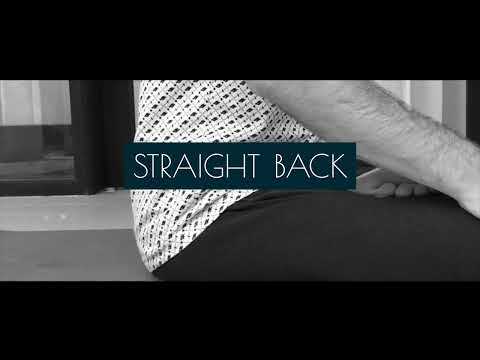
Sit on the sitting bones and let the body rest there, so that the pressure and the effort move into the hips and the pelvis rather than the legs. This is the fine point of the whole arrangement: choose a position you can hold for the entire session without the slightest movement.
It is easy to slide, and then the pressure lands on the legs and the last part of the session becomes much harder. On a firm surface, sitting still on the sitting bones, there is less pain, and a habit forms.
Two cautions. With half lotus, alternate which leg is on top between sittings; you will notice one side takes more pressure than the other. And be careful with full lotus. I have had the phase of deciding I would sit an hour in lotus no matter what, and it always ended in a rebound. That is not progress.
Keep one position for the whole session and do not change it. Every movement coarsens the mind: it is a gross action compared with the breath. The fewer the movements, the finer the attention becomes, and the more of the breath it can pick up.
If you slump — forwards, to one side — notice it, and come slowly back up to a straight spine. Slowly, so as not to throw the mind off what it was doing. And relaxed: a straight back does not mean a rigid one.
The rest is detail, and detail helps. Eyes closed and still, not blinking if you can help it. The tongue tucked to the palate, the tip at the upper teeth, the jaw loose. And if the room is dark, a weak lamp; it keeps you awake better than resolve does.
Watch
New here? Start with these
Related
- Part 1 · Ānāpānasati Essentials
- Practising in a city
- Ānāpānasati: the breath practice everything starts from
More practice notes
- The monkey mind, and who is the “I” that watches itBy the fourth day most people find the mind jumping like a monkey. The same day asks what the “I” is, and the answer comes slowly, by watching the breath.
- Serving a ten-day course: what it teaches that sitting does notHelpers sit three hours a day and work ten, and the ego shows faster in the kitchen than on the cushion. On day six, Ocean DYNN started smiling on purpose.
- Marks in water, sand and stone: what saṅkhāras areThe harder you react, the deeper the mark: a line in water, a groove in sand, a carving in stone. That mark is a saṅkhāra, and not reacting cuts no new one.