Practice note · 28 September 2026
Fifteen days at the Pa-Auk Forest Monastery
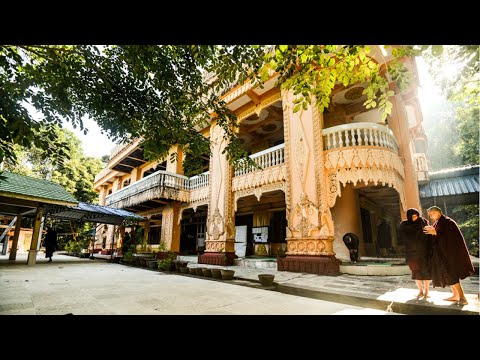
In July 2019 I sat for fifteen days at the forest monastery of the Venerable Pa-Auk Tawya Sayadaw, in Myanmar. I had always wanted to know how monks actually spend a day. What I found was a routine so plain that it took me years to see how much work it was doing.
Myanmar had always looked to me like somewhere difficult to get to, and then I was there, in an authentic forest monastery. On my retreat list it is one plain line: 13 July 2019, Pa-Auk Forest Monastery, fifteen days sitting.
It was in that monastery that I first saw the four-lion capital of King Ashoka — four lions facing the four quarters at once, the image India now uses as its national emblem. I had read about it. Seeing it standing in a forest in Burma put the age of this tradition in front of me in a way that reading had not.
The monks get up early, and early there means around three in the morning. The day starts with an offering of a cup of water to the Buddha, and then they go to the meditation hall.
Several hours of motionless meditation follow: sitting, doing nothing, simply observing the breath. It calms the mind and lets them see what is going on inside it — which thoughts arise, which emotions. I sat with them every morning and tried to stay as unmoving as they were. The hall is high up on the hill, and sitting in it together felt like a journey made as a group, although nobody moved at all. The morning chanting settled whatever doubt was left that this was the most important thing I could be doing with that hour.
They sat like statues, not shifting a millimetre. No reaction, no expectation, no wanting and no pushing away — watching, as a spectator watches, while another film of remembered past and imagined future played itself out.
For them this was not an achievement. It was ordinary life: to pray and to meditate, to stay calm, and not to react to anything. At the time I did not understand how deep the work of silence and an unchanging daily rhythm goes. I understood it later, at home, trying to keep even a small part of it.
Breakfast was different every morning, and that is the point of it. The food comes from whoever offers it that day — cooked dishes, vegetables, fruit, grains, nuts, sometimes even supplements such as spirulina. A monk does not choose. He accepts what the world hands him through other people's hands.
On the way to the dining hall there are large containers where anything he does not want to eat can be left. Then the eating itself is slow: piece by piece, tasting, noticing how the food meets the tongue and what sensations appear in the mouth. It is the same practice as in the hall, carried out with a spoon. Their last intake of the day is juice, at five in the evening.
That last detail belongs to monastic life under its own rule, not to a practice at home. Do not copy it. Nothing on this site asks you to skip meals, and the safety page says plainly not to fast while you meditate.
Among the monks there were thin bodies and quite large ones. Some eat very little and practise a great deal; some eat a lot and practise a great deal. Two weeks of watching that took a question off my mind that I had carried for years: the force of the practice comes from the mind, not from the plate. They work with concentration and with awareness, and whether a monk ate more or less that morning does not reach that work.
A quiet place helps enormously. The mind begins to see what it could not see while it was busy. The habit of an ordinary mind is to be doing something, so when it is made to sit and do nothing it protests that this is abnormal — everyone outside is running around, so surely I should be too.
What I brought home wasn't the schedule. Fifteen days in a forest monastery is not a template for a life with work and a family, and pretending otherwise is how people give up in a week.
What travelled was smaller. Get up earlier. Keep the hour fixed. Sit twice a day, and let the morning stay quiet before anything else touches it. Fifteen minutes in the morning and fifteen in the evening, held every day, does more than an ambitious timetable kept for four days and abandoned. That is exactly what Part 1 of this course asks of you, and it is the part of a monastery that actually fits inside an ordinary week.
Watch
New here? Start with these
Related
More practice notes
- My first ten-day Vipassana course: Dhamma Neru, 2012At twenty, Ocean DYNN sat ten days near Barcelona and stopped wandering in the past and future. Ten months later, almost none of that concentration was left.
- Long breath, short breath: where breath practice beginsYou don't slow the breath or deepen it. You only know it: long or short, coarse or fine. Fifteen minutes shows why that simple instruction is a practice.
- S. N. Goenka and Pa-Auk Sayadaw, and what this course takes from eachIn Goenka's courses the breath gets three days, at Pa-Auk weeks or months. This course gives it thirty days, then takes body scanning from the Goenka tradition.