Practice note · 30 September 2026
The five precepts as hygiene of attention
Every part of this course opens with five undertakings about behaviour, before a word is said about the breath. They are not there to make you a better person. They are there because attention that has to keep arguing with yesterday cannot settle on anything, including a breath.
Think of building a house. Before the walls and the roof, there has to be a foundation. If the foundation is weak, the walls crack, the roof sags, and in time the whole structure comes down.
In practice that foundation is sīla, usually translated as moral discipline. It is not a list of prohibitions. It is a deliberate choice to live in a way that leaves no debris behind you. On it stand the two things the course is actually building: samādhi, concentration, and paññā, wisdom. Without the first, the other two have nothing to rest on.
For the days of a course you undertake:
- to abstain from killing any living being;
- to abstain from taking what is not given;
- to abstain from sexual activity;
- to abstain from false speech;
- to abstain from alcohol and any intoxicant.
In ordinary life the third is kept in its everyday form, as abstaining from sexual misconduct. During a course it is kept as complete abstinence, the way it is kept on a retreat, and it returns to the everyday form when the course ends. The other four do not change; they are simply held more carefully for a few days.
The reason for the precepts is practical, and you can test it inside a week. An unwholesome act does not only harm the other person. At the moment you do it, it floods your own mind with agitation — with strong wanting or strong aversion. Then you sit down an hour later, and that agitation is what you meet on the cushion.
You cannot see to the bottom of a pond while it is being stirred. Self-observation needs a mind that is not busy defending itself. Guilt, fear, a conversation you are still having in your head with somebody — each of them takes the seat the breath was supposed to have. Keeping the precepts is not virtue signalling. It is removing the noise before you try to listen.
Not killing, not stealing and abstaining from sex are easy to keep for five days. Speech is the one that goes. When you talk out of habit you exaggerate slightly, or leave something out to make the story work, and the fourth precept has gone without your noticing it.
If one of the five stones in a foundation starts to shift, everything built on it gets weaker. So during a course, talk less. Less talking, fewer thoughts circling afterwards. It is the least popular instruction in the whole course and the one that changes the most. The same goes for what comes in: films, feeds, messages. The mind that spends the day being filled has to be emptied again before it will sit.
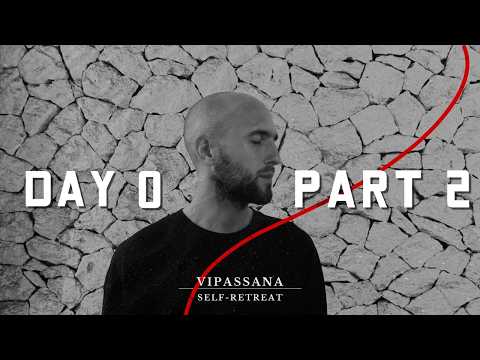
On Day 0, before any instruction about breathing, you set up a practice journal. A physical notebook works better than a file. On the first page you write: Day 0.
Under it you write out the five undertakings by hand, with your own name in them, for the length of the course. Then you add the second half of it: that you will sit twice a day, morning and evening, for the days of the course, and that you accept the process as it comes. Then you sign it.
This looks like a formality, and it is the opposite of one. It is the moment the course stops being something you are reading about and becomes something you have said yes to, in your own handwriting, with nobody watching.
If you're not ready today, don't sign. Choose the day when the yes is clear, and begin then. That is an honest answer and a far better start than a signature you are already negotiating with.
And if you break one halfway through, do not build a second problem on top of the first. Note it. Watch what it costs the next sitting — that is the most useful thing it can teach you. Take the precept again and carry on. Punishing yourself is just more agitation, and agitation was the thing you were trying to put down.
Watch
New here? Start with these
Related
- Part 1 · Ānāpānasati Essentials
- The pond and the stick: why not reacting settles the mind
- Before your first 10-day course
More practice notes
- The pond and the stick: why not reacting settles the mindMeditation doesn't make the mind clear; it stops making it muddy. A pond in Thailand, stirred with a stick and left alone, shows how a sitting settles.
- My first ten-day Vipassana course: Dhamma Neru, 2012At twenty, Ocean DYNN sat ten days near Barcelona and stopped wandering in the past and future. Ten months later, almost none of that concentration was left.
- Long breath, short breath: where breath practice beginsYou don't slow the breath or deepen it. You only know it: long or short, coarse or fine. Fifteen minutes shows why that simple instruction is a practice.